
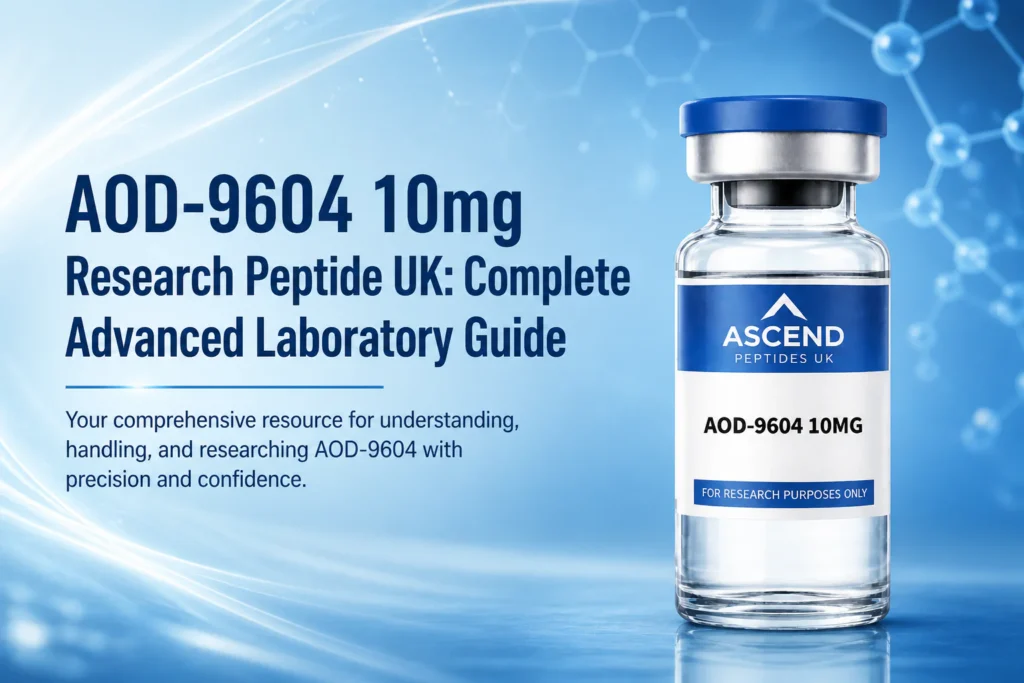
If your laboratory research programme has moved beyond preliminary investigation into AOD-9604 and requires a compound volume that supports full dose-response protocols, multi-arm experimental designs, and extended batch consistency, the AOD-9604 10mg research peptide is the appropriate format for your next phase of work.
The AOD-9604 10mg research peptide is the advanced-format version of the most studied selective lipolysis compound in the UK metabolic research peptide category. Its defining scientific characteristic, selective stimulation of lipolysis through the beta-3 adrenergic receptor pathway without IGF-1 elevation or growth hormone receptor binding, is identical between both formats. What changes at 10mg is research capacity: the ability to run full concentration gradients, parallel experimental arms, and extended single-batch studies without the batch-change variability that limits multi-vial 5mg programmes.
This guide is written specifically for UK-based researchers who are already familiar with AOD-9604 at the 5mg level and are evaluating the 10mg format for an established programme. For a complete introduction to AOD-9604 science, mechanism, and first-time research considerations, see our dedicated AOD-9604 5mg research peptide guide. All content relates strictly to laboratory research. The AOD-9604 10mg research peptide is supplied by Ascend Peptides UK for in-vitro research use only, not for human consumption, veterinary, or clinical application.
What is the AOD-9604 10mg Research Peptide?
AOD-9604 is a synthetic hexadecapeptide derived from the C-terminal region of human growth hormone (hGH) — specifically, amino acids 176 through 191. The “AOD” designation stands for Anti-Obesity Drug, reflecting the original research objective when the compound was developed by scientists at Metabolic Pharmaceuticals in the 1990s. The compound includes a tyrosine (Tyr) residue added to the N-terminus of the native HGH fragment 176-191, a structural modification that distinguishes AOD-9604 from unmodified HGH Fragment 176-191 and contributes to its stability profile in laboratory conditions.
The AOD-9604 10mg research peptide retains the defining pharmacological property of the parent fragment: selective stimulation of lipolysis, the breakdown of stored triglycerides in adipocyte cell models through a pathway independent of the growth hormone receptor (GHR) and independent of IGF-1 production. This IGF-1 independence is the single most important experimental advantage of the AOD 9604 10mg research compound for researchers designing metabolic studies: the absence of IGF-1 elevation means that downstream anabolic, mitogenic, or glucose-modulating confounds associated with full-length hGH are not present in AOD-9604 experimental models.
AOD-9604 10mg Research Peptide — Molecular Identity
|
Identifier |
Value |
|---|---|
|
Scientific name |
AOD-9604 (Anti-Obesity Drug 9604) |
|
Alternative names |
HGH Fragment 176-191 / Tyr-hGH Fragment 177-191 / GH Fragment |
|
Type |
Synthetic hexadecapeptide (16 amino acids) |
|
N-terminal modification |
Tyrosine (Tyr) residue added at the N-terminus |
|
Molecular formula |
C78H123N23O23S2 |
|
Molecular weight |
~1,817.0 Da |
|
Origin |
C-terminal fragment (AA 176-191) of human growth hormone (hGH) |
|
Primary mechanism |
Selective lipolysis via the beta-3 adrenergic receptor pathway |
|
IGF-1 independence |
Does NOT stimulate IGF-1 production — key research advantage |
|
GHR binding |
Does NOT bind growth hormone receptor (GHR) |
|
Research category |
Metabolic Research Peptide |
|
Format (10mg) |
Lyophilised powder — white to off-white |
|
Testing standard |
Janoshik — HPLC + LC-MS verified, ≥98% purity |

Why Choose AOD-9604 10mg for Research? The Case for the Advanced Format
The decision between AOD-9604 5mg and AOD-9604 10mg is not about which compound is superior; the molecular structure, mechanism of action, and purity standard are identical. The decision is about which format is appropriate for the scale and design of your research programme.
The aod 9604 10mg research format becomes the correct choice when your experimental design requires one or more of the following: a full dose-response concentration gradient across multiple wells or treatment groups; parallel experimental arms comparing AOD-9604 with other metabolic research compounds; longitudinal studies requiring consistent compound conditions across multiple time points from a single batch; or high-throughput assay designs where vial-to-vial batch variation would introduce unacceptable experimental noise.
|
Research Consideration |
AOD-9604 5mg |
AOD-9604 10mg |
|---|---|---|
|
Best suited for |
Pilot studies, method validation, preliminary investigations |
Established programmes, multi-arm studies, full dose-response |
|
Research stage |
First-time AOD-9604 research, assay development |
Confirmed research design, ongoing programme |
|
Dose-response range |
Limited concentration gradient |
Full dose-response curve capability |
|
Number of aliquots |
Fewer single-use aliquots per vial |
Greater aliquot volume — fewer batch changes |
|
Batch consistency |
Single-batch for focused pilot series |
Extended single-batch use — critical for reproducibility |
|
Multi-arm protocols |
Single-compound arms only |
Supports parallel compound arms simultaneously |
|
Cost efficiency |
Higher per mg — appropriate for pilot stage |
Better value for active research programmes |
|
Institutional suitability |
CRO pilots, academic method development |
Institutions, established CROs, multi-researcher labs |
|
Purity standard |
≥98% HPLC-verified (Janoshik) |
≥98% HPLC-verified (Janoshik — identical standard) |
For researchers beginning their first investigation with this compound and validating assay conditions before committing to a full programme, the AOD-9604 5mg research peptide guide covers the pilot-stage format in detail, including first-time reconstitution protocols and preliminary dose selection considerations.
Mechanism of Action: How AOD-9604 10mg Works in Laboratory Research Models
Understanding the mechanism of the AOD-9604 10mg research peptide at a molecular level is essential for designing valid experimental protocols and correctly attributing observed outcomes to the compound’s specific activity. Three mechanistic properties define how AOD-9604 behaves in research models.
1. Beta-3 Adrenergic Receptor (β3-AR) Pathway Activation
The primary documented mechanism of AOD-9604 in laboratory research models is activation of the beta-3 adrenergic receptor (β3-AR), a G-protein-coupled receptor expressed predominantly in adipose tissue. β3-AR activation triggers a cAMP-mediated signalling cascade that activates hormone-sensitive lipase (HSL) and adipose triglyceride lipase (ATGL), the two primary enzymes responsible for triglyceride hydrolysis in adipocytes.
The result is liberation of free fatty acids and glycerol, the defining outcome measured in lipolysis assays using the AOD 9604 10mg research compound.
2. IGF-1 Independence — The Key Research Advantage
Unlike full-length hGH, the AOD-9604 10mg research peptide does not bind the growth hormone receptor (GHR) and does not stimulate IGF-1 production through the liver. This independence from the GH-IGF-1 axis is the most scientifically significant property of the compound for experimental design.
Research models using full-length hGH must account for IGF-1 elevation as a confounding variable that independently affects cell proliferation, glucose metabolism, and anabolic signalling. AOD-9604 eliminates this confound entirely, allowing researchers to study fat metabolism pathway contributions in isolation.
3. Lipogenesis Inhibition — The Dual-Action Profile
In addition to stimulating lipolysis, published preclinical research has documented that AOD-9604 inhibits lipogenesis, the biosynthetic pathway through which excess calories are converted into new triglyceride stores.
This dual action, increasing fat breakdown while simultaneously reducing new fat formation, has been observed in multiple rodent adipocyte models and provides a mechanistically distinct experimental profile compared to compounds that affect only one arm of fat metabolism.
The 10mg format allows researchers to study both arms of this dual mechanism across a full concentration gradient within a single batch, without the variability of sourcing multiple 5mg vials.
AOD-9604 10mg vs HGH Fragment 176-191 vs Full-Length hGH
Researchers evaluating the AOD 9604 10mg research compound against related metabolic research tools need clarity on exactly how these compounds differ at the molecular level. The following comparison provides the key distinctions relevant to experimental design.
|
Property |
AOD-9604 10mg |
HGH Fragment 176-191 |
Full-Length hGH |
|---|---|---|---|
|
Amino acids |
16 (+ Tyr N-terminal) |
16 (unmodified) |
191 (full protein) |
|
Molecular weight |
~1,817 Da |
~1,815 Da |
~22,000 Da |
|
N-terminal Tyr |
✓ Added — stability |
✗ No modification |
✗ Not applicable |
|
GHR binding |
✗ Does not bind GHR |
✗ Does not bind GHR |
✓ Primary GHR agonist |
|
IGF-1 stimulation |
✗ No IGF-1 elevation |
✗ No IGF-1 elevation |
✓ Strong IGF-1 release |
|
Lipolysis |
✓✓ Strong in models |
✓✓ Strong in models |
✓ Present but indirect |
|
Anabolic effects |
✗ Not documented |
✗ Not documented |
✓✓ Muscle + bone growth |
|
Glucose effect |
✗ No glucose elevation |
✗ No glucose elevation |
✓✓ Can cause hyperglycaemia |
|
Research advantage |
Modified — greater stability |
Native fragment |
Broad multi-pathway tool |
|
Research category |
Metabolic Research |
Metabolic Research |
Growth Hormone Research |
The practical implication for the AOD 9604 10mg research format specifically: when designing multi-compound metabolic studies that require concurrent investigation of lipolytic mechanisms and growth factor signalling, AOD-9604 and full-length hGH provide mechanistically non-overlapping research probes.
AOD-9604 targets the β3-AR/lipolysis pathway exclusively; full-length hGH engages the GHR/IGF-1/anabolic pathway simultaneously. Running both as independent variables within the same 10mg-scale protocol allows precise pathway dissection that would not be possible with a single compound alone.
Research Applications of AOD-9604 10mg in UK Laboratory Settings
The AOD-9604 10mg research peptide is used across a range of scientific disciplines within the Metabolic Research Peptide category. The following research contexts represent the primary applications documented in published preclinical literature, with specific considerations for the 10mg format.
|
Research Area |
AOD-9604 Role |
Format Recommendation |
|---|---|---|
|
Adipocyte lipolysis research |
Primary tool — selective beta-3 AR stimulation in fat cell models |
5mg for pilot / 10mg for full dose-response |
|
Lipogenesis inhibition studies |
Inhibits new fat accumulation in laboratory adipocyte models |
10mg — multiple concentration arms needed |
|
Metabolic pathway studies |
IGF-1 independent metabolic signalling investigation |
10mg — extended single-batch for longitudinal studies |
|
AOD vs hGH fragment comparison |
Side-by-side lipolytic mechanism comparison |
10mg — dual compound protocols |
|
Cartilage and joint cell research |
Emerging area — cartilage matrix gene expression studies |
5mg for initial investigation |
|
Bone metabolism research |
Potential osteocalcin pathway interactions in bone cell models |
5mg for pilot / 10mg for established study |
|
Beta-3 adrenergic receptor assays |
Selective beta-3 AR agonist probe in receptor biology |
10mg — multi-dose receptor binding studies |
|
Obesity model cell studies |
Differential effect on obese vs lean adipocyte cell models |
10mg — critical for comparative study design |
For researchers whose metabolic study programme also involves growth factor signalling alongside lipolysis research, our IGF-1 LR3 1mg research guide covers the growth factor peptide most commonly used as a mechanistic counterpart to AOD-9604, operating through the IGF-1 receptor pathway rather than the beta-3 adrenergic system, providing a complementary non-overlapping molecular probe for multi-pathway metabolic studies.
For growth hormone axis research that requires upstream GHRH pathway stimulation alongside metabolic compound investigation, our tesamorelin 10mg research guide and CJC-1295 Without DAC research guide cover the GHRH analogue research compounds — mechanistically distinct from AOD-9604 and frequently studied in parallel in comprehensive metabolic research programmes.

Where to Buy AOD-9604 10mg Research Peptide UK
When sourcing the AOD-9604 10mg research peptide in the UK, the quality and analytical verification of the compound are directly linked to the reliability of your experimental data.
A 16-amino acid hexadecapeptide with an N-terminal tyrosine modification requires rigorous analytical confirmation; both purity and structural identity must be independently verified before use in any serious laboratory programme.
As a UK-based aod 9604 10mg supplier, Ascend Peptides UK provides these non-negotiable quality standards for every batch of the AOD-9604 10mg research peptide:
-
HPLC purity verification: ≥98% confirmed by High-Performance Liquid Chromatography, batch-specific, from an independent analytical laboratory
-
LC-MS molecular identity confirmation: Molecular weight verified to match expected AOD-9604 structure (C78H123N23O23S2, MW ~1,817 Da), including confirmation that the N-terminal tyrosine modification is intact
-
Independent third-party testing: All testing performed by Janoshik, a specialist external analytical laboratory, not in-house
-
Lyophilised powder format: Freeze-dried is the only format that maintains long-term stability for this peptide structure
-
Full batch traceability: Complete documentation for publication referencing and institutional compliance reporting
-
Research-only labelling: No health, cosmetic, or clinical claims, clear metabolic research peptide UK designation
-
UK-based dispatch: Same-day shipping for orders placed before 4 pm, no international transit delays or stability risks
Buy AOD-9604 10mg research peptide directly from Ascend Peptides UK, or explore our complete range of metabolic research peptides and scientific compounds, all dispatched same day for orders before 4 pm, with free shipping on orders over £50.
Storage and Reconstitution: Laboratory Reference for AOD-9604 10mg
The AOD-9604 10mg research peptide is supplied as lyophilised (freeze-dried) powder and must be reconstituted before use in laboratory assays.
The 10mg format requires particular attention to aliquoting discipline, given the larger compound volume; a single poor reconstitution or unnecessary freeze-thaw cycle represents a proportionally larger loss of research material.
|
Specification |
AOD-9604 10mg |
|---|---|
|
Supplied form |
Lyophilised powder — white to off-white |
|
Long-term storage |
-20°C freezer — sealed, away from light |
|
Short-term storage |
2–8°C refrigerated — up to 4 weeks maximum |
|
Reconstitution solvent |
Sterile bacteriostatic water (BP grade, preferred) |
|
Alternative solvents |
0.1% acetic acid or sterile saline, where the protocol requires |
|
Addition technique |
Add solvent slowly down the inner vial wall — never directly onto the powder |
|
Dissolution |
Gently swirl or roll — do NOT vortex or shake |
|
Post-reconstitution storage |
Single-use aliquots at -20°C immediately after reconstitution |
|
Freeze-thaw cycles |
Avoid completely — each cycle degrades peptide integrity |
|
Light sensitivity |
Store away from direct light at all times — both lyophilised and reconstituted |
Ascend Peptides UK supplies BP-grade bacteriostatic water for research alongside AOD-9604 10mg, allowing researchers to source their metabolic research peptide and reconstitution solvent from a single UK supplier with same-day dispatch. Bacteriostatic water is the recommended reconstitution solvent for AOD-9604 10mg in the majority of published laboratory protocols.
UK Regulatory Status and Research Compliance
The AOD-9604 10mg research peptide is classified as a research chemical in the United Kingdom. It is not a licensed medicine, not approved for human consumption, and must not be used in any clinical, therapeutic, veterinary, or diagnostic context outside of properly regulated research frameworks. It is not classified as a controlled substance under UK law.
Researchers should note that AOD-9604 completed Phase II clinical trials under the pharmaceutical development programme of Metabolic Pharmaceuticals before the programme was discontinued.
This clinical trial history provides access to a published pharmacokinetic and safety dataset, including human tolerability data that is unusual for a research-stage metabolic peptide. However, this clinical history does not extend any licensed status to the 10mg lyophilised research format, which is supplied strictly for laboratory investigation only.
AOD-9604 is listed on the World Anti-Doping Agency (WADA) Prohibited List and is subject to UK Anti-Doping (UKAD) regulations. Athletes subject to anti-doping regulations must not use this compound.
Researchers working in sports science or applied physiology must account for this classification when designing any protocols involving human subjects.
For any in-vivo animal research conducted in the United Kingdom, full compliance with the Animals (Scientific Procedures) Act 1986 (ASPA) is mandatory, requiring valid Home Office licences and institutional ethical approval.
Why UK Researchers Choose Ascend Peptides UK for AOD-9604 10mg
-
Research-grade purity: Every batch of AOD-9604 10mg is independently tested by Janoshik HPLC + LC-MS with a publicly verifiable Certificate of Analysis (COA)
-
Both formats available: AOD-9604 5mg for pilot work; AOD-9604 10mg for established programmes, allowing seamless format progression without supplier change
-
UK-based aod 9604 10mg supplier UK: Same-day dispatch for orders before 4 pm, no international transit delays
-
Free shipping: On all orders over £50 across the United Kingdom
-
Complete metabolic research range: AOD-9604 available alongside IGF-1 LR3, tesamorelin, CJC-1295, ipamorelin all independently tested
-
Research-only supply: No health, cosmetic, or clinical claims on any product
Frequently Asked Questions AOD-9604 10mg Research Peptide UK
Q: What is the AOD-9604 10mg research peptide?
A: A synthetic 16-amino acid peptide derived from the C-terminal fragment of human growth hormone (hGH 176-191). It selectively stimulates lipolysis through the beta-3 adrenergic receptor pathway without binding the growth hormone receptor or stimulating IGF-1. For laboratory research use only.
Q: What is the difference between AOD-9604 5mg and 10mg?
A: The compound is identical; only the quantity differs. The 5mg format suits pilot studies and method validation. The 10mg format is for established programmes requiring full dose-response gradients, multi-arm designs, and single-batch longitudinal consistency.
Q: What is the difference between AOD-9604 and HGH Fragment 176-191?
A: AOD-9604 includes an additional tyrosine (Tyr) residue at the N-terminus, making it technically Tyr-hGH Fragment 177-191. Both share the same lipolytic mechanism, and neither binds the growth hormone receptor or stimulates IGF-1.
Q: Does AOD-9604 10mg stimulate IGF-1?
A: No. AOD-9604 does not bind the growth hormone receptor (GHR), the activation step that triggers IGF-1 release. This IGF-1 independence eliminates a key confounding variable, allowing clean investigation of lipolytic pathway activity in isolation.
Q: Is AOD-9604 10mg legal in the UK?
A: Yes legal to purchase as a research chemical for laboratory use. It is not a controlled substance under UK law. However, AOD-9604 is listed on the WADA Prohibited List and must not be used by athletes. For research use only.
Q: How should AOD-9604 10mg be stored?
A: Store lyophilised powder at -20°C long-term, or 2–8°C for up to 4 weeks. Once reconstituted, aliquot immediately into single-use volumes and store at -20°C. Avoid freeze-thaw cycles; each cycle degrades peptide integrity.
Q: What reconstitution solvent should I use?
A: BP-grade bacteriostatic water is the most widely referenced solvent in published protocols. Add slowly down the inner vial wall, gently swirl to dissolve, do not shake or vortex. Aliquot immediately and store at -20°C.
Q: What purity standard should AOD-9604 10mg meet?
A: Minimum 98% purity confirmed by HPLC, with LC-MS molecular identity confirmation (C78H123N23O23S2, ~1,817 Da). A batch-specific Certificate of Analysis from an independent third-party laboratory is essential. Ascend Peptides UK uses Janoshik for all testing.
Q: Where can I buy AOD-9604 10mg in the UK?
A: Directly from Ascend Peptides UK, same-day dispatch before 4 pm, free shipping over £50, Janoshik-verified CoA on every vial. For laboratory research use only.
Q: Can AOD-9604 10mg be used in multi-compound protocols?
A: Yes. AOD-9604 operates through the beta-3 adrenergic pathway independent of the IGF-1 axis and GHRH pathway, making it a clean independent variable alongside IGF-1 LR3 or GHRH analogues like CJC-1295 and tesamorelin in multi-compound research designs.
Conclusion: AOD-9604 10mg Research Peptide UK
The AOD-9604 10mg research peptide occupies a well-defined and scientifically important position within the UK metabolic research peptide landscape. Its selective beta-3 adrenergic receptor-mediated lipolysis, combined with confirmed IGF-1 independence and absence of growth hormone receptor binding, makes it the most precise available molecular tool for studying fat metabolism pathways in isolation from the confounds associated with full-length hGH.
At the 10mg format, this precision is delivered with the research capacity required for full dose-response protocols, multi-arm experimental designs, and the single-batch consistency that longitudinal studies demand.
For UK researchers and laboratories sourcing the AOD-9604 10mg research peptide from a reliable UK supplier, Ascend Peptides UK provides this compound to ≥98% HPLC-verified purity, independently tested by Janoshik, with same-day UK dispatch and full batch documentation.
Buy AOD-9604 10mg research peptide today from Ascend Peptides UK.
Scientific References
1. Ng FM, Bornstein J. (1978). Heterogeneity of growth hormone-dependent lipolytic factors. Am J Physiol. 234(5): E521-6. PMID: 645904
2. Heffernan MA, et al. (2001). The effects of human GH and its lipolytic fragment (AOD9604) on lipid metabolism following chronic treatment in obese mice and beta(3)-AR knockout mice. Endocrinology. 142(12):5182-9. PMID: 11713213
3. Ng FM, Sun J, Bharat L, et al. (1990). Metabolic studies of a growth hormone-releasing peptide. J Mol Endocrinol. PMID: 2271479
External authority link: pubchem.ncbi.nlm.nih.gov — Search “AOD-9604” for molecular data
DISCLAIMER
All products supplied by Ascend Peptides UK are intended strictly for research purposes only. They are not intended for human consumption or for any therapeutic, diagnostic, or clinical use. None of the items offered are classified as medicinal products by the MHRA and must not be marketed, presented, or used as such. It is the buyer’s responsibility to ensure that all purchases and usage comply with applicable laws and regulations. Ascend Peptides UK accepts no liability for misuse of products or for any resulting consequences.