
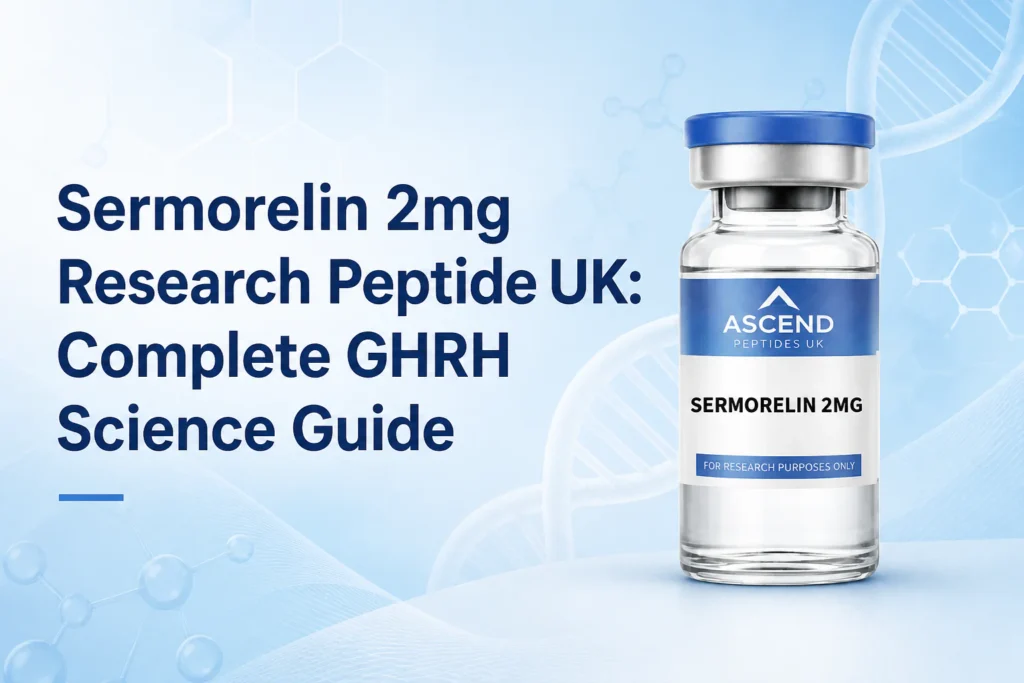
Among the GHRH research peptides available to UK laboratories, the sermorelin 2mg research peptide occupies a scientifically distinct position not because it is the most potent or the longest-acting, but because it is the most physiologically representative.
As a synthetic analogue of the first 29 amino acids of native Growth Hormone Releasing Hormone, sermorelin produces pulsatile GH stimulation with the shortest in vitro half-life of any GHRH research analogue, approximately 12 minutes, making it the most accurate molecular tool available for studying the natural kinetics of GHRH receptor activation without the extended DPP-IV protection of modified analogues like CJC-1295 or tesamorelin.
The sermorelin 2mg research peptide is the entry-format version of this GHRH analogue appropriate for pilot investigations, pharmacokinetic time-course studies, method development, and first-time GHRH receptor research before scaling to the 5mg format for established programmes.
This guide covers its molecular identity, the scientific basis of its unique research value, how it compares to other GHRH analogues, and how to source it from a UK-based sermorelin peptide supplier with same-day dispatch.
All content relates strictly to laboratory research. Ascend Peptides UK supplies sermorelin 2mg laboratory grade as part of our complete range of growth hormone research peptides for UK laboratories for in-vitro research use only, not for human consumption, veterinary, or clinical application.
What is the Sermorelin 2mg Research Peptide? Molecular Identity
Sermorelin, known scientifically as GRF 1-29 NH2, or GHRH(1-29)NH2, is a synthetic peptide corresponding to the first 29 amino acids of the naturally occurring 44-amino acid Growth Hormone Releasing Hormone.
Unlike tesamorelin, which replicates the full 44-amino acid GHRH sequence with N-terminal stabilisation, or CJC-1295 without DAC, which introduces four amino acid substitutions for enhanced DPP-IV resistance, sermorelin makes no structural modifications to the first 29 amino acids of native GHRH.
It is, in that sense, the most structurally conservative GHRH research analogue, the one most closely resembling the natural ligand.
This structural conservatism is both sermorelin’s defining research advantage and its primary pharmacokinetic limitation. Because it carries no DPP-IV protection beyond that provided by the native GHRH sequence itself, the sermorelin 2mg research peptide is degraded relatively rapidly by dipeptidyl aminopeptidase IV in research conditions, producing an in vitro half-life of approximately 12 minutes.
This is the shortest half-life of all three major GHRH research analogues, and, for appropriately designed studies, this kinetic property is precisely what makes sermorelin the correct compound to choose.
Sermorelin 2mg Research Peptide — Molecular Identity Quick Reference
|
Identifier |
Value |
|---|---|
|
Scientific name |
Sermorelin (INN) |
|
Alternative names |
GRF 1-29 NH2 / GHRH(1-29)NH2 / Sermorelin Acetate |
|
Type |
Synthetic truncated GHRH analogue — 29 amino acids |
|
Molecular formula |
C149H246N44O42S |
|
Molecular weight |
3,357.93 Da |
|
Receptor target |
GHRHR (Growth Hormone Releasing Hormone Receptor) — Gs-coupled GPCR |
|
Amino acid coverage |
First 29 AA of native GHRH (44 AA full length) |
|
DPP-IV resistance |
Moderate — less resistant than tesamorelin or CJC-1295 |
|
In vitro half-life |
~12 minutes — shortest of all GHRH research analogues |
|
GH pulse pattern |
Pulsatile — mirrors natural GH secretion closely |
|
Research category |
Growth Hormone Research Peptide (GHRH Analogue) |
|
Format (2mg) |
Lyophilised powder — white to off-white |
|
Testing standard |
Janoshik — HPLC + LC-MS verified, ≥98% purity |

How the Sermorelin 2mg Research Peptide Works — GHRHR Signalling
The sermorelin 2mg research peptide acts as a selective agonist at the Growth Hormone Releasing Hormone Receptor (GHRHR), a Gs-coupled G-protein-coupled receptor expressed on anterior pituitary somatotroph cells. Upon binding to GHRHR, sermorelin initiates the following signalling cascade in laboratory research models:
-
GHRHR activation → Gs protein stimulation → adenylyl cyclase activation → intracellular cAMP elevation
-
Elevated cAMP → protein kinase A (PKA) activation → phosphorylation of downstream transcription factors
-
PKA activation → increased GH mRNA transcription → pulsatile growth hormone secretion from somatotroph cells
-
GH secretion → hepatic IGF-1 production → downstream growth factor signalling cascade
The key mechanistic distinction for experimental design is the relationship between sermorelin’s short half-life and the GH pulse pattern it produces in research models. Because sermorelin is cleared rapidly from the experimental system, approximately 12 minutes, it produces discrete, well-defined GH secretion pulses that closely mirror the natural pulsatile pattern of endogenous GHRH activity.
This physiological accuracy makes the ghrh research peptide sermorelin the preferred compound for time-course studies examining GH pulse amplitude, frequency, and decay kinetics, areas where longer-acting analogues like CJC-1295 without DAC produce sustained stimulation that masks these natural dynamics.
Why Choose the 2mg Format? Sermorelin 2mg vs 5mg for Research
The choice between sermorelin 2mg and sermorelin 5mg is a research-stage decision, not a quality decision. The molecular structure, GHRHR binding affinity, mechanism of action, and purity standard are identical across both formats. What differs is the research capacity each format provides.
|
Research Consideration |
Sermorelin 2mg |
Sermorelin 5mg |
|---|---|---|
|
Best suited for |
Pilot studies, short-term assay validation, and pharmacokinetic profiling |
Established programmes, extended longitudinal studies, multi-arm designs |
|
Research stage |
First-time sermorelin research, method development |
Confirmed design, ongoing programme with validated methods |
|
Half-life study design |
Ideal for repeated pulsatile stimulation assays — shorter windows |
Extended multi-dose pulsatile protocols across longer timeframes |
|
Aliquots available |
Fewer aliquots — sufficient for focused experimental series |
Greater aliquot volume — fewer batch changes in extended studies |
|
Batch consistency |
Single-batch for pilot series |
Extended single-batch — critical for longitudinal reproducibility |
|
Cost efficiency |
Higher per mg — appropriate for pilot stage |
Better value for active research programmes |
|
Comparative studies |
Single-arm GHRH comparison studies |
Multi-arm GHRH analogue comparisons alongside CJC-1295, tesamorelin |
|
Purity standard |
≥98% HPLC-verified (Janoshik) |
≥98% HPLC-verified (Janoshik — identical) |
The sermorelin 2mg laboratory grade format is particularly well-suited to the compound’s primary research application: pharmacokinetic and pulsatile dynamics studies.
Because these protocols typically involve multiple small-volume time-point samples rather than large-volume treatment groups, the 2mg format provides sufficient compound volume for a complete pulsatile time-course experimental series without requiring the full 5mg quantity.
For researchers who have validated their sermorelin protocols and require material for extended longitudinal studies or multi-arm GHRH analogue comparisons, the 5mg format becomes the appropriate choice.
Sermorelin vs CJC-1295 Without DAC vs Tesamorelin — Which GHRH Research Peptide?
UK researchers evaluating the sermorelin 2mg research peptide alongside other GHRH analogues need clarity on the mechanistic and pharmacokinetic differences between these compounds. All three target the same receptor, GHRHR, but through structurally different approaches that produce meaningfully different experimental profiles.
|
Property |
Sermorelin 2mg |
CJC-1295 Without DAC |
Tesamorelin |
|---|---|---|---|
|
Amino acids |
29 (truncated GHRH) |
29 (truncated GHRH) |
44 (full-length GHRH) |
|
N-terminal modification |
None — closest to native GHRH |
4 substitutions (stability) |
Trans-3-hexenoic acid |
|
DPP-IV resistance |
✓ Moderate |
✓✓ High |
✓✓ High |
|
In vitro half-life |
~12 minutes (shortest) |
~30 minutes |
~26 minutes |
|
GHRH receptor coverage |
Partial (29/44 AA) |
Partial (29/44 AA) |
Full (44/44 AA) |
|
GH pulse pattern |
Most physiological |
Pulsatile |
Pulsatile |
|
Closest to native GHRH |
✓✓ Most similar |
✓ Modified |
✓ Modified (full length) |
|
Best research use |
Pharmacokinetic studies, native GHRH comparison |
Most widely studied — combined ipamorelin protocols |
Full receptor engagement studies |
|
Available from Ascend |
✓ 2mg + 5mg |
✓ 10mg |
✓ 5mg + 10mg |
The most important practical distinction for experimental design is the half-life difference. The sermorelin 2mg research peptide, with its ~12-minute in vitro half-life, is the correct compound when experimental design requires precise pulsatile time resolution or when the research question specifically concerns native GHRH pharmacokinetics.
CJC-1295 Without DAC, with greater DPP-IV resistance and a longer activity window, is the appropriate compound for sustained receptor stimulation protocols and is the most widely studied GHRH analogue in combination with ipamorelin. Tesamorelin, the only full-length GHRH analogue, is appropriate when complete receptor interface engagement is the experimental requirement.
For a detailed comparison of CJC-1295 Without DAC, the most widely studied GHRH research peptide in UK laboratories, see our dedicated CJC-1295 Without DAC research guide. For the full-length GHRH analogue with N-terminal stabilisation, see our tesamorelin 10mg research guide.
Research Applications of Sermorelin 2mg in UK Laboratory Settings
|
Research Area |
Sermorelin Role |
Format |
|---|---|---|
|
GHRH pharmacokinetic studies |
Short half-life (~12 min) makes it ideal for precise pulsatile time-course experiments |
2mg — pilot + method validation |
|
GHRHR receptor pharmacology |
Selective GHRHR agonist probe — Gs coupling, cAMP cascade studies |
2mg or 5mg, depending on assay scale |
|
GHRH analogue comparisons |
Baseline reference against CJC-1295 and tesamorelin — closest to native GHRH |
5mg — multi-arm comparative design |
|
GH-IGF-1 axis research |
Upstream GHRH stimulant in pituitary-liver axis pathway studies |
2mg pilot / 5mg for established programme |
|
Pulsatile GH secretion studies |
Most physiologically relevant pulsatile pattern of all GHRH analogues |
2mg — repeated pulse assay protocols |
|
DPP-IV degradation studies |
Known moderate DPP-IV sensitivity makes it a useful reference compound in enzyme kinetic research |
2mg — sufficient for kinetic assays |
|
Combined GHRH + GHRP protocols |
Combined with ipamorelin for dual-pathway synergistic GH research |
5mg — multi-dose combined protocols |
Researchers studying the downstream growth factor component of the GH axis, specifically IGF-1 production and receptor-level activity, should also consider our IGF-1 LR3 1mg research guide. IGF-1 LR3 is the most widely used growth factor research tool for studying the downstream effects of GH axis stimulation in UK laboratory research, and is frequently used in conjunction with GHRH analogues like sermorelin in multi-compound GH axis programmes.
For researchers examining GHRH + GHRP combined pathway activation — the most studied research protocol in the GH peptide category, our ipamorelin 5mg research guide covers how the ghrelin receptor agonist ipamorelin complements sermorelin and other GHRH analogues through mechanistically distinct receptor pathways, producing synergistic GH secretion in research models when used in combination.
Where to Buy Sermorelin 2mg Research Peptide UK
When sourcing the sermorelin 2mg research peptide in the UK, the specific analytical requirements of this compound deserve attention. Because sermorelin carries no N-terminal modification and is structurally closest to native GHRH, confirmation that the supplied compound accurately matches the expected sequence, all 29 amino acids correctly assembled, is particularly important.
Structural errors that might have minimal impact on more heavily modified analogues can produce measurable pharmacokinetic differences in a compound where native-sequence fidelity is the research point.
As a UK-based sermorelin peptide supplier, Ascend Peptides UK provides the following quality standards for every batch of sermorelin 2mg laboratory grade:
-
HPLC purity: ≥98% confirmed by High-Performance Liquid Chromatography, batch-specific, independent analytical laboratory
-
LC-MS identity: Molecular weight verified to match C149H246N44O42S at 3,357.93 Da — sequence fidelity confirmed
-
Independent testing: All analyses by Janoshik’s external specialist laboratory, not in-house
-
Lyophilised format: Freeze-dried powder only correct for the long-term stability of this peptide structure
-
Batch traceability: Full documentation for publication referencing
-
UK-based dispatch: Same-day for orders before 4 pm, no international transit degradation risk
Buy sermorelin 2mg research peptide directly from Ascend Peptides UK, or explore our complete range of growth hormone research peptides for UK laboratories same-day dispatch before 4 pm, free shipping over £50.
Storage and Reconstitution: Laboratory Reference
The sermorelin 2mg research peptide is supplied as lyophilised powder and must be reconstituted before laboratory use.
One practical storage note specific to sermorelin: because its DPP-IV sensitivity means enzymatic degradation can begin relatively quickly in reconstituted solution, single-use aliquoting and strict avoidance of freeze-thaw cycles are particularly important for this compound compared to more DPP-IV-resistant analogues.
|
Specification |
Sermorelin 2mg |
|---|---|
|
Supplied form |
Lyophilised powder — white to off-white |
|
Long-term storage |
-20°C freezer — sealed, protected from light and moisture |
|
Short-term storage |
2–8°C refrigerated — up to 4 weeks maximum |
|
Reconstitution solvent |
BP-grade bacteriostatic water (preferred for extended post-reconstitution stability) |
|
Alternative solvents |
Sterile saline or 0.1% acetic acid, where the experimental protocol requires |
|
Addition technique |
Add solvent slowly down the inner vial wall — never inject directly onto powder |
|
Dissolution |
Gently swirl or roll — do NOT vortex or shake (preserves peptide structure) |
|
Post-reconstitution |
Aliquot immediately into single-use volumes — store at -20°C |
|
Freeze-thaw cycles |
Avoid completely — degrades structural integrity and introduces inconsistency |
|
DPP-IV note |
Sermorelin is moderately susceptible to DPP-IV degradation — minimise exposure time before use |
Ascend Peptides UK supplies BP-grade bacteriostatic water for research alongside sermorelin 2mg. BP-grade bacteriostatic water provides the extended post-reconstitution stability required for multi-day sermorelin research programmes, and is the most widely referenced reconstitution solvent for GHRH analogues in published laboratory protocols.
UK Regulatory Status
The sermorelin 2mg research peptide is classified as a research chemical in the United Kingdom. It is not a licensed medicine, not approved for human consumption, and must not be used in any clinical, therapeutic, veterinary, or diagnostic context. It is not a controlled substance under UK law.
Sermorelin has a significant clinical history: it was approved by the FDA under the brand name Geref for specific clinical indications before market withdrawal. This approval history provides access to published pharmacokinetic and safety data.
However, this clinical history does not extend any licensed status to the lyophilised research format supplied by Ascend Peptides UK, which is designated strictly for in-vitro laboratory research.
Sermorelin is listed on the WADA Prohibited List; athletes subject to anti-doping regulations must not use this compound. UK researchers must comply with all applicable UK legislation, including the Animals (Scientific Procedures) Act 1986 (ASPA), for any in vivo research.
Conclusion: Sermorelin 2mg Research Peptide UK
The sermorelin 2mg research peptide occupies a well-defined and scientifically important niche within the UK GHRH research analogue landscape. Its structural conservatism 29 amino acids of native GHRH with no modifications, makes it the most physiologically representative GHRH research tool available, producing pulsatile GH stimulation with the shortest, most precisely measurable in vitro activity window of any GHRH analogue.
For UK laboratories conducting pharmacokinetic studies, GHRHR receptor biology research, native GHRH baseline comparisons, or pilot investigations ahead of larger-scale GHRH programme work, sermorelin 2mg is the appropriate molecular tool.
Buy sermorelin 2mg research peptide from Ascend Peptides UK, independently tested by Janoshik, ≥98% HPLC-verified purity, same-day UK dispatch.
Frequently Asked Questions — Sermorelin 2mg Research Peptide UK
Q: What is the sermorelin 2mg research peptide?
A: Sermorelin 2mg (GRF 1-29 NH2) is a synthetic 29-amino acid GHRH analogue — the first 29 residues of native GHRH with no structural modifications. It is a selective GHRHR agonist that produces pulsatile GH secretion in research models with the shortest in vitro half-life (~12 min) of all GHRH research analogues. For laboratory research use only.
Q: What is the difference between sermorelin 2mg and 5mg?
A: The compound is identical; only the quantity differs. The 2mg format suits pilot studies, pharmacokinetic time-course assays, and first-time sermorelin research. The 5mg format is for established programmes requiring extended single-batch consistency, multi-arm designs, or long-duration longitudinal studies. Both from Ascend Peptides UK to ≥98% HPLC-verified purity.
Q: How does sermorelin differ from CJC-1295 without DAC?
A: Both are 29-amino acid GHRH analogues targeting GHRHR. The key differences: sermorelin has no structural modifications closest to native GHRH with ~12-minute half-life. CJC-1295 Without DAC carries four amino acid substitutions for enhanced DPP-IV resistance and longer activity. Choose sermorelin for native pharmacokinetic studies; CJC-1295 for sustained stimulation and combined ipamorelin protocols.
Q: What makes sermorelin unique among GHRH research peptides?
A: Sermorelin is the only GHRH research analogue with no structural modifications, making it the most physiologically representative of native GHRH. Its ~12-minute half-life produces the most precisely pulsatile GH secretion pattern of any GHRH analogue, making it the preferred compound for pharmacokinetic studies and native GHRH baseline comparisons.
Q: Is sermorelin 2mg research peptide legal in the UK?
A: Yes, legal to purchase as a research chemical for legitimate laboratory use. Not a controlled substance under UK law. However, sermorelin is listed on the WADA Prohibited List and must not be used by athletes. Not approved for human consumption or clinical use. All buyers are responsible for compliance with applicable UK regulations.
Q: Can Sermorelin 2mg be combined with ipamorelin in research?
A: Yes. Because sermorelin targets GHRHR and ipamorelin targets GHS-R1a (ghrelin receptor), they operate through mechanistically distinct pathways. Combined protocols using both compounds simultaneously produce synergistic GH secretion in research models — the two pathways are complementary. This is one of the most studied combined GHRH+GHRP protocols in GH research literature.
Q: How should sermorelin 2mg be stored?
A: Store lyophilised powder at -20°C long-term, or 2–8°C for up to 4 weeks. Once reconstituted, aliquot immediately and store at -20°C. Avoid freeze-thaw cycles, particularly important for sermorelin, given its moderate DPP-IV sensitivity. Use within the recommended period post-reconstitution.
Q: Where can I buy Sermorelin 2mg research peptide in the UK?
A: Directly from Ascend Peptides UK, same-day dispatch before 4 pm, free shipping over £50. Every vial is independently tested by Janoshik with a publicly verifiable Certificate of Analysis. Sermorelin 2mg and 5mg are both available. For laboratory research use only.
Q: What purity should Sermorelin 2mg meet for research use?
A: Minimum ≥98% HPLC-verified purity, with LC-MS molecular identity confirmation matching C149H246N44O42S at 3,357.93 Da. Sequence accuracy is particularly important for sermorelin; the compound’s research value depends on structural fidelity to native GHRH(1-29). An independent third-party CoA from a specialist analytical laboratory is essential.
Scientific References
1. Frohman LA, Jansson JO. (1986). Growth hormone-releasing hormone. Endocr Rev. 7(3):223-53. PMID: 2876996
2. Lance VA, Murphy WA, Sueiras-Diaz J, Coy DH. (1984). Super-active analogues of growth hormone-releasing factor (1-29)-amide. Biochem Biophys Res Commun. 119(1):265-72. PMID: 6712931
3. Prakash A, Goa KL. (1999). Sermorelin: a review of its use in the diagnosis and treatment of children with idiopathic growth hormone deficiency. BioDrugs. 12(2):139-57. PMID: 18031173
External authority link: pubchem.ncbi.nlm.nih.gov — Search “Sermorelin” CID 16132483 for molecular data
DISCLAIMER
All products supplied by Ascend Peptides UK are intended strictly for research purposes only. They are not intended for human consumption or for any therapeutic, diagnostic, or clinical use. None of the items offered are classified as medicinal products by the MHRA and must not be marketed, presented, or used as such. It is the buyer’s responsibility to ensure that all purchases and usage comply with applicable laws and regulations. Ascend Peptides UK accepts no liability for misuse.